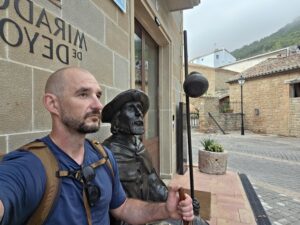
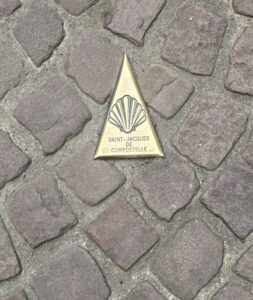
Let me just start by saying, there is something inherently ridiculous about waking up every morning for 30+ days, strapping twenty pounds of your belongings to your back, and voluntarily walking twenty-five to thirty kilometers across mountains, valleys, and medieval villages. And yet, that’s exactly what we did.
I will be breaking up the trip in thirds for a couple reasons. For starters, there is so much to share. And second, the first third of the Camino de Santiago, from Saint-Jean-Pied-de-Port in France to Burgos, Spain, is supposedly the part that tests your body. The second tests your mind, and the third your spirit. Whether there’s any truth to that depends on who you ask. But after the first stretch, I’m inclined to believe whoever came up with it knew what they were talking about. Because, the road began by throwing us directly up and over the Pyrenees.
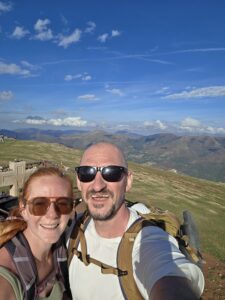
We followed the famous Route Napoléon, climbing high above Saint-Jean-Pied-de-Port toward the Spanish border. Despite the name, the route was used by travelers and pilgrims long before Napoleon’s armies crossed the mountains. It has an impressive history. In fact, somewhere near Roncesvalles, Charlemagne’s rear guard was ambushed in 778, an event that would eventually inspire one of France’s earliest works of literature: The Song of Roland.
On that day, I had more immediate concerns.
There were were no sounds on day one, just the deafening roar of the wind. It swept across the mountains with enough force to make us feel like France itself was dragging us back across her border. Every step forward seemed to require two steps to the side and at times a step back. And that was only the beginning.
Twenty-five kilometers doesn’t sound particularly intimidating on paper. But twenty-five kilometers carrying everything you own, followed by another twenty-five the next day, and the next, was a different proposition entirely.
Our shoulders ached. Our hips were tense. Blisters appeared on top of other blisters. And each morning seemed to reveal yet muscle we didn’t know existed until now because it hurt.
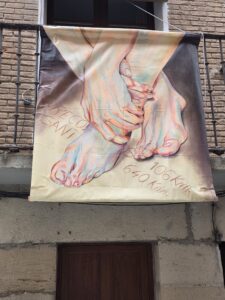
The Camino didn’t care how enthusiastic we were when we started. It simply asked whether we were willing to take another step. Somehow, we did. And eventually, the wind of the Pyrenees gave way to something quieter.
I remember walking through a forest one morning where the only sounds were water moving through the riverbeds, birds calling from the trees, and the faint ringing of a cowbell somewhere beyond the trail. A gentle breeze carried the scent of autumn through the leaves, and for a while, the only evidence of our presence was the crunch of gravel beneath our boots.
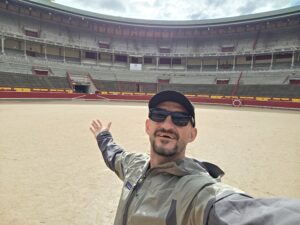
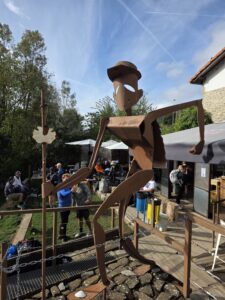
It’s remarkable how much you begin to notice when the world stops competing for your attention. The sweetness in the air beyond Pamplona. The church spire at Sansol rising above the plains like a lighthouse guiding pilgrims toward safe passage. The way farmers had cultivated their fields right up to the trees, allowing strips of nature to remain between their crops rather than clearing out every last inch of land.
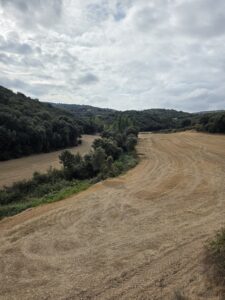
That last one stayed with me.
For a while now, I’ve felt as though so much of my life has been spent making room for more. More work. More money. More responsibilities. More opportunities. If something stood in the way, I removed it. If there was an empty space, I filled it. Yet here were fields that seemed perfectly content to leave a little room for the trees. Maybe there’s a lesson in that. Or maybe I was just tired and becoming unusually philosophical about agriculture. Either way, I liked it.
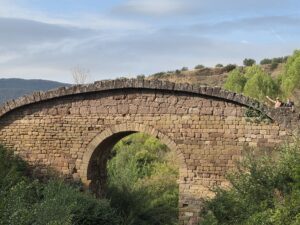
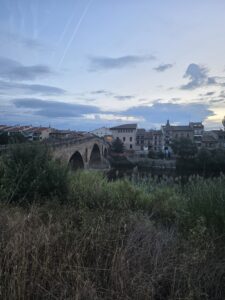
The towns themselves carried their own stories. Puente la Reina grew around a medieval bridge built to help pilgrims cross the Arga River. Estella, meanwhile, was deliberately developed into a thriving town for pilgrims in the eleventh century. These weren’t simply picturesque villages. They were places that had been welcoming tired, hungry, and occasionally bewildered pilgrims for centuries.
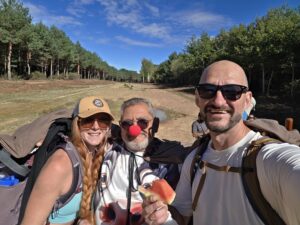
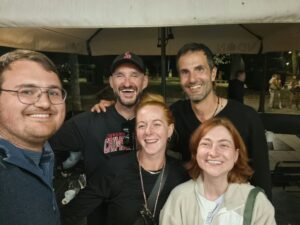
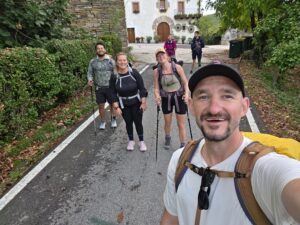
And then there were the people. The Camino, I’ve discovered, behaves a little like an accordion. People come together, spread apart, and somehow find their way back to one another again. You might walk beside someone for hours, share a meal, and then not see them for days. Just when you’ve assumed they’re somewhere far ahead or behind, you turn a corner in another village and there they are, sitting outside a café as though they’d been waiting for you all along.
At first, I found that difficult. You meet people, share stories, and develop the strange familiarity that comes from spending several exhausting days together. Then, without much warning, they’re gone. Sometimes it’s simply because their pace changes. Other times, the Camino makes the decision for them.
By the time we reached Logroño, several people we’d come to know had changed their plans or left the trail altogether. Infected blisters, shin splints, and injuries had taken their toll. One friend lost part of his toe…literally. After walking through the rain, he’d felt something moving around inside his boot. When he finally removed it, he discovered that a piece of his toe had come off. Needless to say, his Camino ended there.
It was a sobering reminder that determination and enthusiasm weren’t always enough. Sometimes the body simply refused to cooperate. But the accordion continued.
There was a French woman who had walked from northern France carrying a twenty-five-pound backpack, sleeping beneath bridges and wherever else she could find shelter, all while wearing just flip-flops.
Then there was the Finnish pilgrim we kept encountering in town after town, almost invariably sitting somewhere with a liter of beer in front of him. We initially gave him a name of our own because we didn’t know his. Eventually, we learned his actual name, and what began as a running joke became another friendship.
And somewhere out there was a man searching for a lost stuffed dinosaur, occasionally walking in the opposite direction from everyone else. I couldn’t help wondering how many extra kilometers he’d accumulated in pursuit of that little creature.
The Camino was full of people like this.
As we got to know these people, we also got to know ourselves as well, and we began to change. The first week felt like a race. Wake up early. Get moving. Reach the next town. Find a bed. Repeat. But eventually we stopped setting alarms. We started waking when we were ready, taking our time over coffee, and allowing ourselves to enjoy the places we were passing through.
Of course, the Camino had a way of ensuring we didn’t become too pleased with ourselves. For every glorious stretch of forest or open countryside, there seemed to be another several kilometers beside a highway. I hated those stretches.
Cars and trucks rushed past, carrying people toward jobs, appointments, errands, and whatever else required them to get somewhere as quickly as possible. Meanwhile, we were walking along the shoulder, moving at a different pace. The contrast was difficult to ignore.
On one side, the modern world raced forward. On the other, a small procession of people carried everything they needed on their backs, stopping for water, conversation, or simply because a view deserved a few minutes of their time. A refusal, however temporary, to believe that every minute must be productive or that every journey must be completed as efficiently as possible.
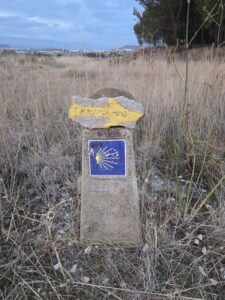
With each passing day, the responsibilities waiting back home became a little quieter. I still checked my phone. I still glanced at my emails and the various things that ordinarily demanded my attention. But increasingly, I found myself putting it away.
One afternoon, Kaitlin and I found ourselves sitting in a beautiful little garden behind a bar, listening to the gentle trickle of a fountain. The sun was warm. There was a cold beer on the table and a Hemingway book in my hands. And I remember thinking, quite honestly, does life get much better than this? We’d walked all morning. We’d earned the afternoon. There was absolutely nowhere else we needed to be.
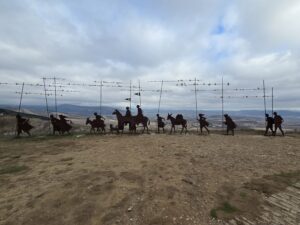
Although I should probably admit that the Camino also encouraged a somewhat questionable relationship with wine. One morning, Kaitlin and I woke up to discover that the bottle we’d purchased the previous evening was almost entirely untouched, as were the glasses we’d poured. Apparently, we’d reached the point where buying wine had become such an automatic part of the evening that we’d forgotten we were too exhausted to drink it.
I liked to imagine medieval pilgrims soothing their aching feet and weary muscles with generous quantities of wine and ale. I have chosen to believe we were honoring that tradition.
But of all the things I remember from those first weeks, it’s the mornings that have stayed with me most. There was something therapeutic about the familiar little routine. Packing away the sleeping bag. Discarding the disposable sheets. Tying up the sandals to the backpack. Pulling on the boots one more time. Then stepping outside into the crisp darkness before sunrise, when the streets were quiet and the world hadn’t quite woken up.
We knew we’d walk. We knew our feet would hurt. We knew there would be another village, another climb, another meal, and eventually another bed. But beyond that, we had absolutely no idea what the day would bring. The world revealed itself differently each time.
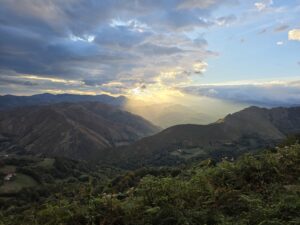
One morning, as we walked through the mountains, the sun began breaking through the clouds above the cliffs. Great shafts of light reached down into the valley, illuminating the landscape in patches of gold while everything around them remained in shadow. It looked as though God’s hand itself was reaching down through the clouds and, for a few moments, I forgot about my aching legs, the weight of my backpack, and how many kilometers remained before lunch. I just stood there. Looking.
There was nothing particularly extraordinary happening, at least not in any scientific sense. The sun was rising. The clouds were moving. Light was doing what light does. But knowing how something works doesn’t necessarily make it any less miraculous to witness.
It’s hard not to be religious about the road. Or at least spiritual.
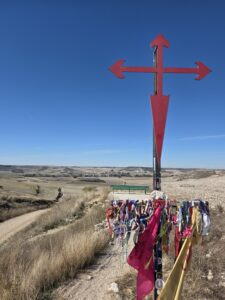
I don’t mean that I suddenly discovered all the answers to life’s great mysteries somewhere between a blister and a steep hill. In fact, I remained somewhat suspicious of the expectation that everyone walking the Camino had to experience some profound personal revelation and the people searching for exactly that.
A spiritual awakening. A moment of clarity. Some unmistakable sign that the journey had changed them. Perhaps some did find it. I never did. At least, not in the way I imagine such a thing happening. But maybe that morning was enough. Maybe, the Camino didn’t need to deliver some grand revelation to be worthwhile. Maybe it was enough to find yourself standing in a valley, exhausted and humbled, feeling grateful simply to be there.
I have come to suspect that the Camino gives people what they were willing to notice, rather than what they arrived expecting to find. And sometimes, what you found was considerably less profound than you’d hoped.
In Santo Domingo de la Calzada, for instance, I was particularly excited to visit the cathedral associated with the famous legend of the hanged pilgrim and the miraculous chickens. According to the story, a young pilgrim was wrongfully accused of theft and hanged. However, through the intervention of Saint James himself, the boy survived the gallows while his parents completed their pilgrimage.
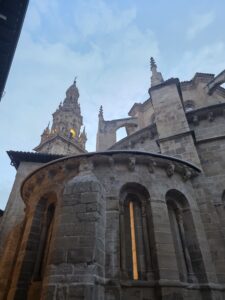
When they returned and discovered their son alive, they rushed to tell the local magistrate, who was preparing to eat two chickens roasting over the coals. He dismissed their claim, declaring that their son was no more alive than the chickens he was cooking. At which point, naturally, the chickens sprang back to life.
It’s a wonderful story. And the cathedral in Santo Domingo became famous for keeping roosters and hens on the premises, said to be descendants of the birds from the story.
Naturally, I wanted to see the chickens. But after wandering around outside the cathedral, I couldn’t find them anywhere. I assumed they must be inside. So, for the first time on the Camino, I decided to attend a pilgrim Mass and blessing. We were directed toward another building where the service was supposed to take place, and after receiving conflicting information about the time, I waited with the other pilgrims. Unfortunately, the priest never arrived.
No chickens. No priest. Just a collection of confused pilgrims standing around a church.
I couldn’t help imagining the priest sitting comfortably somewhere with a glass of wine, blissfully unaware that a small international delegation of strangers was waiting for him.
There was something wonderfully ironic about the whole experience. We’d walked hundreds of kilometers along a route steeped in religious tradition, following a pilgrimage that had endured for more than a thousand years, and I couldn’t even manage to find a priest. Or a chicken, for that matter. And yet, the following morning, we all got up and kept walking.
Maybe there was a lesson in that, too.
The Camino wasn’t particularly interested in meeting our expectations. It didn’t promise comfortable weather, good company, spiritual revelations, or even functioning church services. It simply offered the road. What we made of it was largely up to us.
And looking back on those first few hundred kilometers between Saint-Jean-Pied-de-Port and Burgos, I can see how much changed without us really noticing.
Our bodies grew stronger. Our packs began to feel lighter. The urgency that defined those first few days slowly gave way. We learned to appreciate the people who walked beside us, even when we knew they might disappear around the next bend. We learned that sometimes the best thing you could do was stop, order a beer, and read a book in the sunshine. And most importantly, we began to understand that the Camino wasn’t something we needed to conquer. It was something we needed to experience.
One of the best pieces of advice I received along the way was remarkably simple: Don’t go backwards. But always look back.
I’ve thought about that advice a lot now that we’re done walking. When you’re climbing a mountain, it’s easy to become so focused on the next step, the next bend, or the summit somewhere above you that you forget to appreciate how far you’ve already come.
You keep your head down. You push forward. You tell yourself you’ll stop when you reach the top. But some of the best views aren’t waiting at the summit. They’re behind you. And if you never stop to turn around, you might reach the top without ever really understanding what it took to get there.
I think there’s something worth remembering in that, both on the Camino and elsewhere in life.
We’re often so preoccupied with where we’re going that we forget to appreciate where we’ve been. The difficult stretches. The people who walked beside us. The small victories that didn’t seem particularly important at the time. Sometimes, the most rewarding part of a climb isn’t reaching the summit. It’s actually turning around, looking back down the mountain, and realizing just how far you’ve come.